Rogues Gallery
A Texas Prison Fable By BH Shepherd
Legend has it the first man ever incarcerated in Sanchez Penitentiary
was a preacher named Drake Church, prisoner number 00000-000. Since the first day the prison opened there has always been a Cell Zero, under a reinforced steel trapdoor in a sub- basement. Grainy black and whites show an iron cross mounted on the door, but no sign of a handle. The original writ of arrest was still on file in the warden’s office, dated over a hundred years ago. What records still exist state only that Church had been convicted of crimes against God and Humanity and was sentenced to prison for the duration of his life. The presiding judge had felt compelled to further stipulate that Prisoner Church only be released on the condition of his demise. Now, even a century later, the guards still superstitiously fear the boogeyman of Cell Zero. They avoid it on their rounds and deny it is there, as if they were surrounded by anything but monsters.
Let me tell you something—the natural state of the world is madness.
Our delusions of order are merely the briefest interludes within the greater symphonies of chaos. Once you understand that, anything is possible. That’s why they locked me in here. I know the sick, maddening truth. I know it and they’re afraid if they let me out it will burn off society’s face like napalm. They think they can stop it, fix it or hide it. But it’s still there. It’s always there.

My father understood. Even if he didn’t know it, he understood all too well. He was head of the psychiatric staff at the prison, and conversed
on a daily basis with the most twisted minds the penal system had to offer. I grew up in the shadow of Sanchez Penitentiary, a giant cinderblock fortress perched on the El Paso horizon like a gargoyle standing watch over the desert. When I wasyoung and God-fearing I would gaze out my window at dusk and watch as the cross atop the chapel steeple impaled the heart of the sun. Sometimes late at night I would sneak out of bed and down the hall to find Father in his study, surrounded by open books and scattered papers, working on a bottle of scotch. Shrouded in a fog of blue cigar smoke, safe from my shushing mother, I dared to ask my father about his work. Usually he would regale me with the more whimsical chunks of madmen’s ramblings, and sent me back to bed with one of the prison’s many ghost stories. I always asked if he talked to Drake Church and he always said of course not, Cell Zero was nothing more than a tradition. Church himself was just a folktale, a scary story parents told to naughty children. No, he assured me as he sank into his leather chair, there were plenty enough real monsters within the walls of Sanchez. He would confess frustration at his continual failure to cure or even treat the criminally psychotic, to doubts that he had ever done any good, to worries that he alone stood sentry at the gates of insanity. My father denied every rumor and did his best to discourage my interest in his world. So on the nights I didn’t find my father ensconced in his study, I read about it myself. Did he ever guess, I wonder?
The curiosity of Drake Church had only sparked my interest. The more I read the more my morbid fascination grew into an obsession with
the penitentiary and its lore, so old and dusty that fact and legend had become tantalizingly entwined. I studied it all compulsively, poring over my father’s patient files by flashlight and collecting every scrap of ink ever printed about Sanchez. In secret coded notebooks beneath my floorboards I charted the lives and careers of its most notorious inmates, endlessly diagramming and analyzing in an effort to discover the true nature of evil. What that was, I couldn’t tell you. I don’t even think evil exists, not anymore. But I was singularly fascinated with the big gray box where we locked up all our worst nightmares.
Sanchez Penitentiary regularly housed around 3,000 felons, men who had drowned themselves in desperation and violence. Among their
ranks were unlucky kingpins, armies of loyal thugs, ambitious assassins, a handful of hustlers, pimps, bank robbers, and even a small community of psychopaths. Sex freaks were rare; they had a short shelf-life in Sanchez. Most were violent offenders, murderers of various degrees, career criminals beyond the possibility of reform. Over the decades of its operation Sanchez acquired an accurate reputation as a tough place to do time, so the courts kept sending them tough men to break. Sanchez had been built to contain “all conceivable evils,” Warden Gunn, one of the founders of the penitentiary, explained. But since Man was so often confronted with the inconceivable, sometimes maximum security would not be enough. You can’t put too many big fish in a tiny bowl and shake it; you end up with a lot of dead fish. After a long and brutal summer of riots and jailbreaks Warden Gunn introduced his vision of “Supermax” security to much fanfare and praise from lawmakers and law enforcement. Cellblock Thirteen was built to cage the monsters, the worst of the worst, and the public slept soundly knowing that their nightmares were locked safely away.
“But what if they got out?” I would always ask my father.
And always he would shake his head and say, “No one gets out of Cellblock Thirteen.”
Cellblock was a rather generous title for this place, stark by even prison standards. Just a hole in the bedrock beneath the sub-basement.
They poured in concrete around Cell Zero, then carved out a block with nine eight-by-six cells. It’s an oven in the summers and a meat-locker every winter. Each cell has two doors—one five inch steel slab on the outside with a latched view/feed slot, and a layer of more traditional bars inside that could only be opened remotely by a series of switches in the checkpoint station outside the main block. Usually those switches didn’t do much but gather dust. All of us were in permanent solitary, under twenty-three hour lockdown. No humanrights allowed. We got eight hours of fluorescent twilight each day, just enough to stare at the walls, or read if you still had your library privileges. “Privileges” didn’t mean you actually got to visit the library, but if you behaved yourself the guards would take requests and bring you state- approved literature once a month. Of course, my book wasn’t on the list. I was forbidden even a pencil to do the sudoku and crossword puzzles in the newspapers I read courtesy of the taxpaying masses.
Not that I ever needed one; I solved them at a glance, able to see the answers as clearly as the imaginary chessboard upon which I
occasionally matched wits with the prisoner next door, Luther “Buck” Grady, prisoner number 00078-991, an old Grand Wizard of the KKK serving seven consecutive life sentences for bombing black churches. He claimed to have killed more people than the Great Depression, and was credited with inventing “bucking”, a favorite neo-Nazi pastime that involved kicking in minority skulls. Grady may have been an old and ornery racist white trash redneck, but he was a cunning bastard, a brilliant tactician who often challenged me as we hollered our moves down the hallway. Officer Daniels, the regular nightshifter in the checkpoint station, was kind enough to keep track on a real board and act as referee when Buck would inevitably forget where the pieces were and accuse me of being a no good rotten cheater. When he wasn’t moving chess pieces for us, I could hear the squawk of daytime television from the checkpoint station, and I wished I could watch, if only to dull my mind. One night when the set was receiving nothing but static, I offered to take a look at it. He reluctantly agreed and I was happy to fix it for him, if only for something to do. I read War and Peace and Moby Dick and the entirety of Ray Bradbury; I wallpapered my cell with every clipping on Sanchez I could find and folded an entire army of origami birds from the scraps, all to combat the boredom, but it was not a battle that could be won. At least, not until the day Officer Daniels made his fatal mistake.
Every now and then the COs tossed a rookie down here to toughen him up. The old guards, the ones with the thousand-yard stare who
never seemed to rotate out, were there for the same reason we were: punishment. If you fucked up in Sanchez above, say you get caught running cigarettes or beat a prisoner to death, you got sent down to the dungeon to watch the bad men. New guards always think Cellblock Thirteen is going to be a cake watch. Policy down here is fairly basic: lock ‘em up and throw away the key. We’re kept in reinforced cages all day and night so they think we can’t possibly hurt them. They feel safe knowing another set of iron bars separates our block from the rest of the prison, and if any inmate crossed the threshold unchained and without escort, orders were to shoot to kill. They tend to forget that although Sanchez has no shortage of killers in its population, only ten merited life sentences down here. But I guess it’s hard to fear someone you feed through a slot in the door like an animal. To be honest, “animal” might be too generous a term. We are often called monsters when we are spoken of at all, and it’s hard to argue. Cellblock Thirteen was full of men who had made lives out of doing all those things decent folk would call “unspeakable.” The lowest body count down here is twenty-seven, the number of children consumed by Father Steven Bird, prisoner number 00132-446. With the priest’s sole exception, all of our numbers had doubled or even tripled since incarceration. It was the El Paso Post that called us “The Rogues Gallery of Sanchez Penitentiary,” describing its residents as “culled from the very scum of the Earth.” It didn’t win them any Pulitzers, but one thing was clear to everyone except Officer Daniels—Cellblock Thirteen was not a place you wanted to go. We had killed for survival, love, money and fame, sometimes all of the above. But the really scary ones, the guys that keep convicted mass-murderers up sweating all alone in the dark, were those of us who needed no reason at all. It was fun.
“Why not?” was the ethos of Andrew “Psychoman” Ravage, prisoner number 05571-673. He was a patient of my father’s until he stabbed
him in the kneecap with a ballpoint pen and was transferred to Cellblock Thirteen. Father would never talk about him, but he was one of the Post’s favorite villains. A quiet, unremarkable man who had worked as a custodian at several schools, he was the last person you would expect to have a three-digit body count. But Ravage had been killing with impunity all over Texas for over twenty years, for no discernible motive other than his own morbid amusement. He was finally caught when a teacher stumbled onto his cache of humantrophies in the janitor’s closet. When the authorities demanded to know why he would do such things, Ravage simply scratched his head and shrugged. “I didn’t have anything else to do.” The papers branded him Psychoman and he was cast into the depths of Cellblock Thirteen, out of sight and out of mind, so that decent citizens might sleep easier. But he was still there. There we all were, trapped and brooding as the law strove to put a tourniquet on chaos.
About once a month Warden Burke would come down to rally the troops. The COs were told to always handle us with the utmost care
and vigilance, not only for their own safety, but the safety of the community at large. It was their sworn duty to keep us in there, and the warden wanted them to take it as seriously as a heart attack every single day. Guards died in Cellblock Thirteen. Fine, they knew the risks. But if just one of us got out, people died. Innocent people.
“That’s on us,” Warden Burke would growl. “We let them out, then everything thing they do is our fault, because we failed in our duty.
And I’ll be goddamned if I’m gonna lose any sleep because one of you fucked up.”
These speeches always concluded with a cautionary tale; there were plenty to choose from in the ignominious history of Sanchez
Penitentiary. One of my favorites, and I suppose it must have been the warden’s as well, for he told it often, was the tragedy of Sergeant Coolidge, formerly the head guard on the cellblock. Coolidge had avery corporal, hands-on approach to discipline. He was a fan of random acts of shame and violence, order through intimidation. The guards were in charge of this block, he declared, and it was the prisoners who should fear them. To drive this point home, he would often toss a prisoner’s cell and then deliver a savage beating upon the occupant regardless of what was found. I was one of Coolidge’s favorite targets for these demonstrations, as I was not big, strong, or well-connected. I did my best to take my lumps in dignified silence, but there’s really no dignity to be found when you’re getting stomped by five men built like refrigerators. Then one day Coolidge was either feeling lucky or stupid, because he decided at the last minute to raid Cell 4, Dok Phu, prisoner number 09766- 883. Dok the Dragon was a skinny one-eyed Thai pirate who had been captured in the Louisiana swamplands. He was incarcerated at Dixon Correctional, where he left a pile of bodies before being transferred to Sanchez and condemned to Cellblock Thirteen. The rest of the inmates knew Dok was harder than Chinese algebra and not to be fucked with.
“Coolidge made a mistake,” the warden would say, glaring at his troops through a fog of cigar smoke. “He assumed that because his
prisoner was in his cell he was helpless. Then he opened that door and found out just how helpless he was.” Not very. Coolidge didn’t see Dok rush the bars, didn’t see the bony hands reaching through until they grabbed the sides of his squarish head and squeezed. Then he saw that Dok’s long thumbnails had been filed down to razor sharp points. For just a moment, he saw them plunge into his eyes. He screamed, and then he never saw anything again. Coolidge was on disability less than a month before he fed himself a load of buckshot.
“There are worse things than death, gentlemen” the warden would state ominously. “And these bastards in here know how to do all of
them. Don’t forget that. Not one of these prisoners is leaving Sanchez unless it’s in a bodybag. If you’re not careful, if you’re cocky like Sergeant Coolidge was,” emphasis on the was, “you’ll be leaving the same way.” When the warden made his dramatic exit, I was always tempted to shout BOO! at the nearest guard, but I never thought it worth a kick in the teeth.
Once a day they took us for a walk in a concrete yard rimmed with barbed wire under the watchful eye of rooftop snipers. Ten unlucky guards
would armor up and then painstakingly apply all the restraints necessary to remove us from our cells. I merited only an ordinary pair of handcuffs, but a big bruiser like Snake Jones got the full treatment: arm shackles and leg irons, even a metal collar attached to a long steel pole manned by two of the biggest guards. Only half of us were still retained our outdoor privileges, the ones that could still be controlled, like Father Bird, who only wanted to be left alone to pray for God’s forgiveness. Luther Grady had finally gotten his privileges back by turning ninety-five. He walked like a hunchback bent over his lightweight plastic cane, coughing wretchedly as he smoked the unfiltered Pall Malls smuggled to him by loyal young Klansmen serving time up above us. The guards ignored him almost entirely—he was a harmless, irrelevant old man and hardly worth incurring the wrath of the KKK. I would often walk with him, as it was the only time I was spared the pestering and ridicule of the guards, as I was the easiest and safest target available.
Ideology aside, we had a lot in common. I would talk shop with Luther as he shuffled around the perimeter. We compared notes on blasting
caps, trigger mechanisms, and recipes for dynamite. His bombs were simple contraptions, but very effective. His knowledge of primers, timers, and old fashioned tampers dwarfed my own, and he had forgotten more about booby-trapping than I would ever know. He had not only blown up his share of buildings, but had assassinated men with explosives concealed in clocks, coffee cans, doorknobs and even a Bible. He was fascinated when I explained the properties and applications of explosive gels, and I must admit to being impressed by his ballpoint pen bomb. Luther couldn’t comprehend the end of the Civil War, but he understood a bomb as a work of art, the meticulous layering of chemicals and mechanics to craft an explosion, the hatefulpoetry of war, verses that survived only in the traumas of the witness. We both knew the sweet agony of the seconds between pulling the trigger and witnessing the moment of ultimate conclusion, and the ecstasy of detonation. The brilliant flash and deafening thunder banging in your head just before the shockwave hits you in the chest like a jackboot, clouds of dust and shrapnel flying past you as a fireball of your own handmade fury wipes a place off the map. You feel like God getting a blowjob.
Our talks always stopped short of actual war stories. We shared the pains of having things literally blow up in our faces, but we were
casualties of different wars, separated by miles of scar tissue. Luther continued to fight even though his side had lost a long time
ago, while my fight would never end.
We were discussing our favorite methods of sabotage on that fateful day when there was a commotion at the weight bench. There were
three workout junkies in our group—Dodge Hardin, Snake Jones, and Iceberg Rawlins. Hardin was known as the Last Gunfighter, notorious for killing seven Texas Rangers with a six-gun, but he wasn’t quite as scary without a weapon in his hand. After a scuffle with Snake over the free-weights a black-eyed Hardin had avoided the equipment.
Snake Jones was the biggest thug in Sanchez, a seven-foot wall of muscle. He was ugly as sin, with skin like old leather stretched across his
shaved box head and lantern jaw. A film of gray stubble covered his dome, which gave way to a sloped brow the covered dark, deep-set eyes. Snake was meaner than Hitler and the best damn fighter I’d ever seen. He was in prison less than twenty minutes before he killed a guard with his bare hands. In the illegal bareknuckle brawls the officers of Cellblock Five arranged for their inmates he was unstoppable, soaking up punishment like a sponge until he unloaded all that hurt right back in the unlucky bastard’s face, smashing and pounding like a rampaging beast. Crates of cigarettes and more than a few paychecks were won and lost over his fights, and soon the inmates had a hero, of sorts. Snake Jones was the one man in Sanchez who never took shit from anybody, and soon not only the guards but Warden Burke began to worry about what would happen should they lose control of such a dangerous animal. So they drugged his food, trussed him up in five-point restraints and shipped him down to Cellblock Thirteen. Snake didn’t have outside privileges his first year down here, because he crippled the first three guards that tried to take him out. Being walked in a metal dog collar had done nothing to improve his disposition. So when anybody asked Snake to move, it was a sure bet the answer was “Fuck off.”
Maybe Iceberg didn’t hear him. More likely, he didn’t care. Iceberg Rawlins was a real Renaissance thug, a self-made crack kingpin from
the streets of Houston. When he stood trial he was charged with trafficking in drugs, cars, weapons, women and murder. Iceberg believed in leading by example, and so put two hollow-points in the gut of a junkie that tried to roll one of his dealers. It was just tough luck that the junkie survived and worse yet, had a badge. A dead cop, even a dirty one, was a heavy enough albatross to sink Iceberg to the bottom of Sanchez Penitentiary. Nobody cared if he used to be a somebody on the outside; in here he was just another inmate hustling dope. After he strangled a guard that tried to stiff him, the powers that be threw him to Cellblock Thirteen and forgot about him. Ever since, Iceberg had delighted in asserting his dominance over me. He made a point of following my every misfortune, always racing to be the first to kick me when I was down, laughing with sadistic glee. There was no petty annoyance beneath him. Whenever the guards came in to clean the cells or feed us Iceberg would engage them in long and repetitious debates about football, sitcoms and rap music, tediously trying to bore me to death. If I tried to sleep or read he would just talk louder, whistle and sing songs he only half remembered, or worse, rap about what an ice cool badass he was. Whenever there was a book my hand, he slapped it to the ground. The guards even looked away in silent approval when he would throw meto the ground and deliver a few kidney punches, or maybe put me in a sleeper hold. To him, I was just harmless entertainment. I was no one’s favorite prisoner, but I was Iceberg’s favorite joke. I suppose that day in the exercise yard he was determined to remind us all exactly who Iceberg Rawlins was—a stupid thug whose mouth was bigger than his brain.
Snake ignored him, like he does all who are smaller than him, but for whatever reason Iceberg felt entitled to be first on the weight bench
that day. He grabbed Snake’s arm, or tried to, and told him he could spot him. The hulking brute shoved the little gangster aside and lifted the weight effortlessly with one hand and did a few arm curls.
“Spots are for girls and guys Luther’s age,” Snake said. “What’s your excuse?”
Luther coughed a wheezy laugh as Iceberg squared off with Snake. “Ten packs says the big man kills him.”
“No bet,” I replied. That much was a foregone conclusion. None of the scenarios spinning through my head went well for the
gangster, and I was intrigued to see just which nasty end he was about
to meet. Just in case he was about to come to his senses, I gave
Iceberg a little encouragement.
“You really gonna take that shit, Iceberg?” I hollered, loud enough for all to hear. “Big, bad gangster getting told by some redneck cracker?
I thought you were hard, man. Guess I lost ten bucks.”
Iceberg glared at Snake, his eyes narrowing into thin slits in his dark contorted face. He bolted toward the bench and howled with rage as
he sprang off it and attacked Snake with the weight of his entire body. To my surprise, Snake actually reeled when Iceberg’s shoulder connected with his chin. He took a few steps back and shook his head as Iceberg jumped up and tensed for another strike. The guards moved forward as if to intervene, but stopped as if they thought better of it. Perhaps they didn’t want to miss this fight either. More likely they didn’t want to get between Snake and his next victim. The gangster spit at the giant. He declared that nobody told Iceberg Rawlins what to do. Snake just smiled and opened his arms wide.
“C’mon then, tough guy,” he said. “Teach me a lesson.”
Iceberg moved quickly, closing the distance between them and started raining punches on his opponent. Snake weathered it all with a
contemptuous grin and didn’t seem to be in any pain, even when Iceberg threw all his fury behind one last haymaker. He just rubbed
his chin while Iceberg leaned on the bench, panting with effort.
“Is that it?” chuckled Snake. Iceberg lunged again, but this time Snake caught him by the wrist. “Now I know why they sent you
down here, Snowflake.” He gave the arm a hard twist downward and Iceberg wailed in agony as his carpals separated from his metacarpals with a series of pops and cracks. “It’s because you hit like a ninety year old faggot.” Iceberg took another swing with his free arm, but the blow merely glanced off his shoulder. Snake yanked him close and slammed his forehead into the gangster’s nose, shattering it with a wet crunch. Blood squirted from the sucking hole in the middle of his face as Snake swept his feet and elbowed him hard in the throat. Iceberg hit the bricks hard, bleeding and gurgling. Snake backed away and reflexively put his hands behind his head and started to assume the position.
The fight didn’t even last a whole minute. Frankly, I was amazed Iceberg was still alive and more than a little disappointed the
fun was over so soon. Before the guards could reach either combatant I saw one last opportunity to fan the flames.
“Damn, Iceberg,” I hollered, “couldn’t you even make it look like a fight?” The guards shared a chuckle over that one while Iceberg
fumed. Then Luther decided to join in the fun and add insult to injury.
“He got fucked up worse than a nigger’s checkbook.” Then the guards laughed out loud and Iceberg lost it. He grabbed a thirty pound weight
off the rack and hurled it at Snake. Guards dived out of the way as it flew straight for his face, but Snake reached out and plucked it from the air like it was no more than a metal Frisbee. As an enraged Iceberg made his final foolish charge Snake backhanded him across the face with the weight and he flopped on the ground, his neck bent at a perfect ninety degree angle. Two guards broke off for grave detail while the rest tasered Snake into submission.
“Damn, Isaac,” Luther chuckled as we lined up to be shackled. “That’s gotta be the most fun I had since they shipped me down here back
in ’87. You know I haven’t killed anyone in almost twenty years?”
“Don’t worry, Luther,” I told him. “I doubt you’ve forgotten how. It’s just like riding a bike.”
Luther raised a wispy eyebrow and looked like he wanted to ask me something further, but once Snake was secured we were
quickly separated and stuffed back in our cells. The less he knew the better. I wanted it to be a surprise for everyone.
There was an execution scheduled the next morning. After I fixed his TV, Daniels told me the word had finally come down to give Dok
the Dragon the chair. Since Coolidge’s widow had sued the state and the Thai government had declined to comment on his citizenship, the government had decided it would be prudent to go ahead and kill him. A decade had passed since they dusted off Old Sparky. A bunch of judges had ruled it cruel and unusual punishment, but they still made it available as an alternative to lethal injection. Believe it or not, there were still those who would rather ride the lightning than take a shot, and Dok was definitely the former. I lay awake in my cell all night staring at the ceiling, giddy with anticipation like a five year old on Christmas.
They came for him at six in the morning, just like cops. Dok was getting a closed execution; only essential staff, the coroner, and
Warden Burke would be present, just to insure he was killed properly in accordance with the law. I listened as four pairs of boots shuffledhim out of his cell, past the checkpoint and up the stairs.
Only a matter of time now. I stretched, did a few pushups and paced my cell until I heard the muffled grunts and curses of a shift change.
A fresh rotation of guards was here to take us for our morning stroll, with no clue what the day had in store for them. The gate eased open and shut on its electric track and guards took up positions outside our cells. Heavy locks clanged as they were turned by a jingling ring of keys passed up and down the block. Our steel doors swung open. We were ordered to turn around and back toward the bars so they could put us in restraints. I didn’t move, just smiled back at Officer Bragg as he demanded to know if I wanted to go outside or not. Oh, I was going outside all right, but I was done with restraint.
The lights flickered overhead as they sent Dok to Hell. As the sudden power surge coursed through the faulty circuit I had left in
Daniels’ TV it shorted out. The spark ignited a capacitor I had packed with a homemade concoction I liked to call Bang Powder, and it lived up to the name. The small explosion kicked off a cascade failure in the checkpoint control systems. There was a loud bang from up the hall, the sizzle of sparks and the gasp of flames spreading. Then everything went dark. As the fire alarm clanged the guards in the block began to yell at Daniels for a full lockdown as the bars popped open. If Daniels heard them, it was too late. The rogues were loose.
Guards screamed for backup as the inmates howled with bloodlust. Hard thumps accompanied the wet cracks of hand to hand violence
as shouts of rage, pain and fear echoed throughout the dungeon. I made no move until Bragg scurried off to help the others with Snake Jones. It sounded like a troop of boy scouts trying to subdue a bear. I heard Father Bird pleading with his fellow inmates to show mercy and ask forgiveness, but his begging was cut short by an unceremonious snap. When the shouting had finally ceased, I peered into the dark and saw a mound of limp figures laying at the feet of a giant shadow. Several other shades moved in the dustclouds, adding more bodies to the pile. All of the cells hung open and empty, all except Cell Zero, which remained stoic and impassive at the end of the hall, utterly indifferent to our jailbreak.
Luther let out a whistle as he staggered out of his cell. “They sure did fuck up.”
I walked over to the pile. “Did you leave anyone alive? Anyone who can still talk?”
“Bout all this one can do is talk,” Dodge said as he heaved another body on the pile.
Snake reached down and plucked him up by the throat. “Tell them to open that damn gate,” he growled. “Open that gate, or I’m gonna twist
yer neck shut.” The guard cried out that he couldn’t do that and desperately began to explain why, but Snake snapped his
neck and tossed him aside. “Get me another one!” he hollered.
“Wait!” I shouted. “Don’t kill them yet.”
Snake dropped the next contestant back on the pile. “Why not?”
“Daniels can still open the gate manually,” I explained. “But he won’t if you kill all the hostages. Let me do the talking; just back me up.”
“Back you up?” grunted Snake. “Who the hell do you—”
“Do you want to just kill a few more guards before you begin the rest of your life sentence, or do you want to get out of here?” I yelled at
him, holding eye contact as I bit back mortal fear. “Trust me, I’m the smartest guy in the room here. Move the live ones to cells Seven and Eight. There’s only two armed guards plus Daniels. He’s weak and scared shitless. He will do as I say.” Snake and Dodge looked at each other for a moment, then shrugged and got to work doing exactly as they were told.
“Now what, Einstein?” Snake asked when they finished.
“Tell Daniels to open the gate,” I said. “Be unfriendly.”
“DANIELS!” Snake’s gravelly bass bellowed down the hall of Cellblock Thirteen. “Best open that gate!” Of course Daniels’ said he
couldn’t, and Snake threatened to kill every last man in there until he did, starting with Officer Bragg. He said he would break him in half. Daniels again said he couldn’t, and Snake did just as he promised, over his knee. He flung the folded officer out into the corridor, right in front of the checkpoint station.
“Tell him to let us out now or you’ll turn all his friends into origami,” I whispered.
“Orgy what now?” asked Snake.
“Never mind. Just tell him you’ll fold up every last one of his friends unless he opens that gate.” He did, but Daniels continued to insist
he could not do so without power. Snake grabbed another wounded officer.
“Easy!” I hissed. “Let me reason with him.”
“Right,” he snorted. “He’s gonna listen to you.”
“He will,” I said, “because he’s not afraid of me. Yet.”
I shouted down the hall to Daniels. “Come now, Officer! You’re required to have a manual override for that gate by law, so that we may
evacuate in case of an emergency. Your friend Officer Velasquez is on his knees here begging for mercy, and I don’t think Snake has any left. Trust me, Daniels. This is an emergency.”
“I... I don’t know what you’re talking about, Isaac,” Daniels stammered.
I nodded to Dodge, who hauled Velasquez to his knees. “Do something terrible,” I instructed Snake.
“How terrible?”
“Make sure Daniels can hear how much it hurts.”
Snake nodded, lifted one massive foot and stomped it clean through the officer’s leg. There was a loud crack, followed by Velasquez
screaming for Jesus, Mami, anybody as he fell over and flopped like a salmon in a puddle of his own blood. White bone shone through the soaking red gash in his trousers. I had to give Snake credit; it was very effective. As soon as I threatened to do that to his
other leg Velasquez burst into tears, crying no, no, no and Daniels cracked. I let Snake do it anyway and Daniels’ resolve was shattered by his buddy’s scream. He begged us to stop; he would open the gate. I heard him rummaging through the equipment locker, then the door slamming as he rushed to the gate. The other two guards tried to argue with him, so I offered these words of encouragement: “Hand over the weapons, boys, or Velasquez’s hands are next. After that, Snake gets creative.” There was a pause, followed by the clatter of two shotguns and three service revolvers on the floor. A blunt clang as the manual lever locked into place, followed by the ponderous turning of the mechanism, and finally the satisfying grunt of the lock opening. Dodge scooped up one of the shotguns and put a rubber bullet in each of the guards’ heads. Out of the shadows darted a tall and skeletal white man, stark naked and dripping with blood. He screamed a wild streak of gibberish as he bolted out of the gate, balls flapping in the wind as he disappeared down the corridor.
“Shouldn’t we stop him?” asked Snake. “He’s gonna give us all away.”
“It’s just Psychoman,” I said. “He’s off to do something crazy, and while they’re all busy chasing him, we take the mess hall.”
“Ain’t hungry,” muttered Dodge as he loaded rubber slugs into the shotgun.
At least three different alarms were going full blast, covering any noise we might have made on our way to the mess hall full of pissed
off convicts eating bad food. The breakfast crowd needed only the scent of blood and the slightest push to blow into a full- scale riot. Once the chairs and trays started flying, Luther and I set fire to chapel, to create further chaos and also to wreck the visibility for the snipers waiting to gun us down on our way to the exit. Dodge climbed one of the towers with a shiv between his teeth, and not long after six single shots signaled the end of the snipers. He continued to pick off guards as we made our way toward the gate—the number of people he managed to kill with the non-lethal ordinance was nothing short of astonishing. The mess hall exploded, belching flames and broken glass from its barred windows before the roof collapsed.
“Was that you?” I asked Luther.
“My own family recipe,” the old man wheezed. “Serves a whole congregation.”
Snake barreled through everything the remaining guards could throw at him. Rubber bullets and tasers seemed to only infuriate him further
as he smashed and pummeled his way forward. I handed him a blunt object and we simply followed in the wake of his mayhem. Luther tripped and fell over a severed head rolling by. As I helped him to his feet, I glanced back and saw a whirlwind of bloodstained metal shredding all who approached us, and when it squealed with glee I was certain Psychoman was covering our backs. He might’ve been insane, but he still knew I was his best shot at continuing his murder spree outside of Sanchez. By the time we reached the gatehouse, all the guards were dead or fleeing back toward the mess hall. I ripped open a control panel and quickly hotwired our freedom. The gates yawned wide and all the surviving monsters streamed back into the world at large.
Let me tell you something—it was magnificent. I wished Father could see me now. He would be so proud of all my accomplishments.
The world was returning to its natural state.
THE END
But Wait!
There’s More!
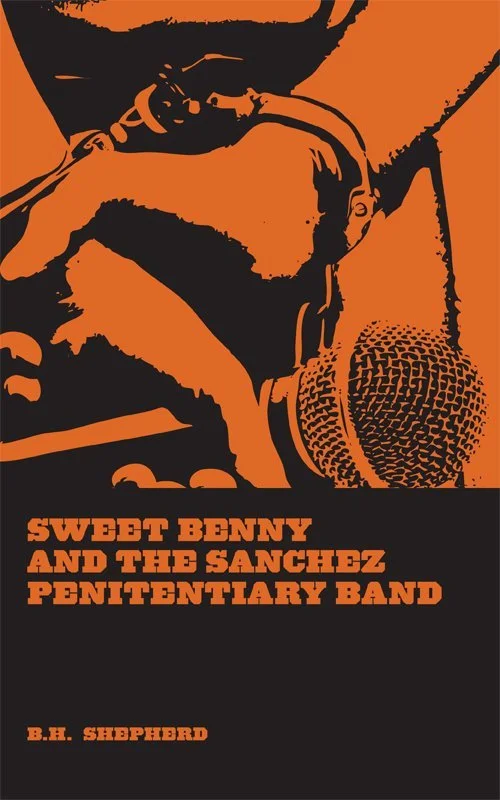
Get another free story, “Sweet Benny and the Sanchez Penitentiary Band,” when you join the mailing list.
Ready for a Whole Novel?
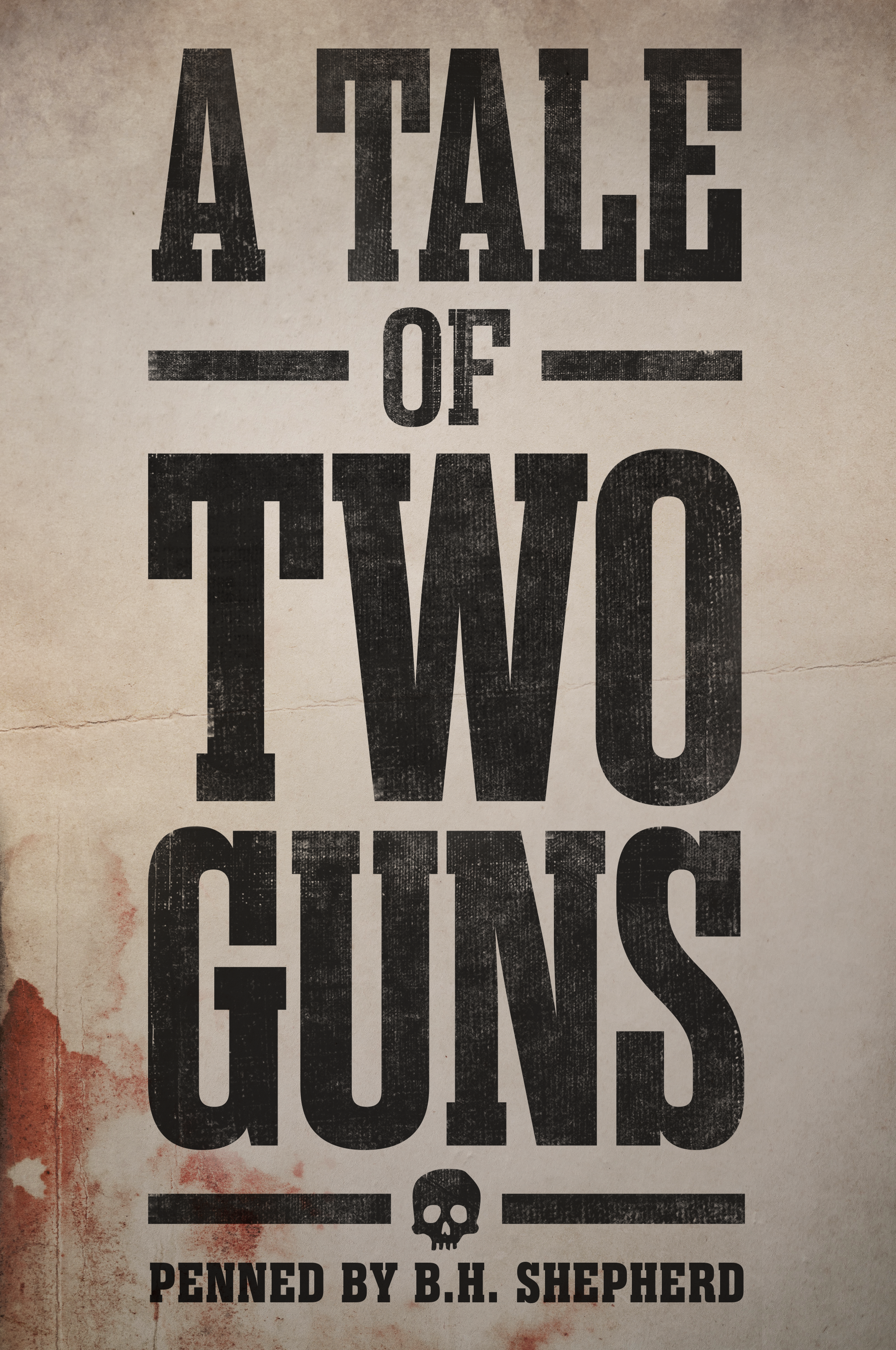
Roger Hardin was just a kid from Nowhere. A crackerjack shot and good with his hands, like his father. Roger grew up hearing the legends of The Devil’s Iron and the Wrath of God—two fabled revolvers that changed the course of history in the hands of mythic gunslingers such as One-Eyed Dragan and the Red Marshal. He wasn’t sure they were true until he saw his father murdered by a man carrying the Devil’s Iron. Roger takes his first step to joining this pantheon of pistoleros when he vows to kill that man. His name is Erebus Basilica, known to many as the Prince of Bastards. But vengeance won’t be simple as a showdown at high noon, because Erebus is the leader of the Brotherhood of Blood, the oldest and most feared biker gang in Texas.
A Tale of Two Guns shifts between two time periods. The past follows the bloody trail the legendary guns have left through Texas history, from the death of the cattle drive to the birth of the truck stop town. The guns were carried by both folk heroes like the Man in Black, and notorious outlaws like Drake Church, whom the papers labelled “The Most Dangerous Man in Texas.” In the present (West Texas in the 1990’s), Roger searches for the Wrath of God and assaults Brotherhood operations with the help of his unhinged pal Eddie and his girl Thana—daughter of Erebus Basilica—hoping to destroy the gang for good. But there is a reason the Brotherhood has lasted so long, and despite knowing the history, Roger may still be doomed to repeat it.

Sweet Benny, a young hustler from New Orleans, just got out of prison. Looking for a new game, he starts a blues band with four fellow cons at a bar called Sue's in El Paso. Thanks to word of mouth and a sound that shoots from, and sometimes straight through, the heart, they are invited to play at Austin City Limits, the biggest live music festival in the South. Their ill-fated journey across Texas is narrated by James Creedence, a cynical one-hit wonder author who has finally found a reason to write again. As Benny takes the band on the road, they encounter many obstacles. Flat tires, voodoo curses, savage biker thugs and a crooked sheriff all threaten to cut short their quest to become rock n' roll legends. Wherever the Sanchez Penitentiary Band plays trouble is sure to follow, and Creedence is there to chronicle the hilarity and disaster that ensues.
The first novel from BH Shepherd, Sweet Benny and the Sanchez Penitentiary Band is a classic tale of bad men who make good music, and the stories that become songs.

Over three billion people live in Complex City, the last human place left when the Robo Wars ended twenty-three years ago. One of those people is a young woman named Razor, and she knows the city’s hazards better than most—she used to be one of them. Maybe she still is.
A syndicate cyborg assassin since the age of seven, Razor has finally earned her freedom after fifteen years of bloody service. She was ready to relax and enjoy her retirement, but then Kaoru (her BFF) got kidnapped by her own boyfriend. Now Razor must return to the underworld she just escaped in order to find her friend before she gets sold into servitude… or worse. The deeper Razor sinks into the dark industries of Complex City, the more determined she becomes that everyone involved in Kaoru’s kidnapping, from the lowliest flesh peddler to the richest syndicate executive, is going to get exactly what they deserve.
Retirement over. Time to go back to work.